
Cost of Living in Hoi An | My Realistic Budget

Hoi An is still a pleasant and relatively affordable city to live in for a few months in Vietnam, but it is no longer an ultra-cheap destination. Good rentals are becoming harder to find, and prices have tended to increase since 2025-2026.
Your budget will mainly depend on your accommodation, your eating habits and your lifestyle. If you eat local food, get around by bicycle and live simply, Hoi An remains very affordable. But with a comfortable house, imported products, air conditioning, visas and a few outings, the monthly cost can rise quickly.
In this article, I give you a realistic budget for living in Hoi An, whether you are alone, a couple or a family.
How much should you budget per month in Hoi An?
To live comfortably in Hoi An today, I would budget around these amounts:
| Profile | Realistic monthly budget | What to keep in mind |
|---|---|---|
| Single person | $900 to $1,400 | Possible with a simple rental, few imported products and a more local lifestyle. |
| Couple | $1,200 to $2,000 | Comfortable if the rent stays reasonable. |
| Family | $1,800 to $3,000 | Excluding international school. Accommodation, food and health costs can quickly increase the budget. |
You can live on less, especially if you eat local food and find a simple rental. But for a stay of several months, you need to allow some margin. You will not necessarily eat Vietnamese food every day, and expenses such as visas, health insurance, electricity with air conditioning or imported products can quickly increase your budget.
Rent remains the biggest expense, and it is often what determines whether your budget stays reasonable or not. In Hoi An, there are big differences between a small simple rental and a comfortable, well-located house.
Accommodation in Hoi An
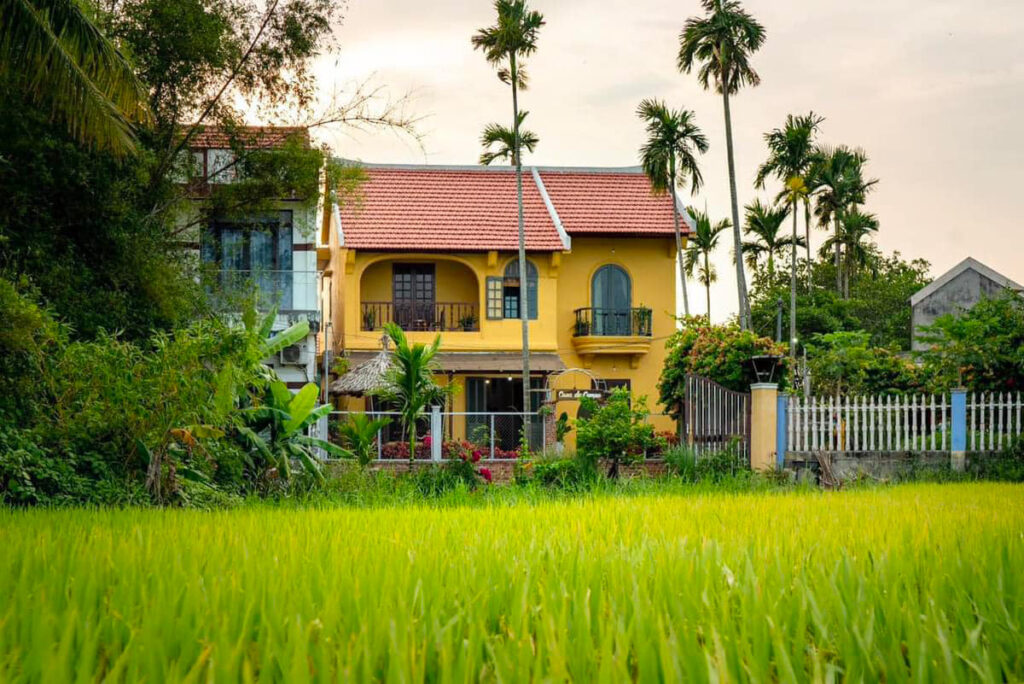
Accommodation is the expense that can change your budget the most. Simple rentals still exist in Hoi An, but it is becoming difficult to find decent accommodation for less than 15 million VND per month. At that price, you often have to accept a compromise: an older house, a less convenient location, humidity or a basic kitchen.
| Type of accommodation | Realistic budget | Comments |
|---|---|---|
| Simple rental | 12 to 15 million VND / month | Possible, but often with compromises. |
| Comfortable accommodation | 15 to 25 million VND / month | The most realistic budget for living properly. |
| Modern house with garden or pool | 30 to 40 million VND / month | Sometimes more depending on the area and season. |
I also recommend avoiding signing a long-term rental agreement remotely. Spend a few days on site first, test the neighborhood, check the noise, karaoke, humidity, air conditioning, Wi-Fi and the real distance to the old town or the beach.
Also check the air conditioning before renting. Many homes only have air conditioning in the bedrooms, not in the living room. In summer, temperatures can get very high, sometimes close to 40°C. Believe me, this is the kind of detail you want to check before signing.
The best areas to live in Hoi An
For a stay of several months, I would prioritize Cam Chau, An Bang or Cam Thanh. These are among the most practical areas for everyday life without being too exposed to flooding.
| Area | Advantages | What to watch |
|---|---|---|
| Cam Chau | Quiet, residential, good compromise between the old town and the beach. | Some parts are less practical without a bicycle or scooter. |
| An Bang | Ideal if you want to live near the sea. | Rents are often higher. |
| Cam Thanh | Greener, quieter, with often larger houses. | A little farther from the old town. |
| Old town | Convenient for a few days, everything is nearby. | Less suitable for long-term living, especially during the rainy season. |
| An Hoi / Cam Nam Island / riverside | Sometimes pleasant and well located. | More exposed to flooding. |
I would be more careful with An Hoi, Cam Nam and the streets close to the Thu Bon River. These areas can be practical and pleasant, but they are also more exposed to flooding during the rainy season. Having lived in Cam Nam for 11 years, I experienced flooding almost every year.
Food budget in Hoi An

Food can be very cheap in Hoi An if you eat local. A simple Vietnamese dish often costs between 30,000 and 70,000 VND ($1.20 to $2.50), excluding drinks. This is one of the big advantages of the city.
But for a stay of several months, you need to be realistic: you probably will not eat Vietnamese food every day, especially if you have children. As soon as you start buying Western products, the budget increases quickly.
A simple packet of pasta often costs around 50,000 VND, or about $2. Grated Gruyère is around 60,000 VND, about $2.50, and butter can easily reach 120,000 VND, or around $4.50. Cereals, cheese and other imported products are often even more expensive.
| Product | Usual price | Approx. |
|---|---|---|
| Simple Vietnamese dish | 30,000 to 70,000 VND | $1.20 to $2.50 |
| Packet of pasta | 50,000 VND | $2 |
| Grated Gruyère | 60,000 VND | $2.50 |
| Butter | 120,000 VND | $4.50 |
For a single person, I would budget $200 to $400 per month to eat properly. For a couple, more like $350 to $700. For a family, $500 to $900, depending on the share of Vietnamese meals, Western restaurants and imported products.
Transport: bicycle, scooter and Grab

Hoi An is an easy city to live in without a car. The center is flat, distances are short and a bicycle is often enough for daily life, especially if you live between Cam Chau, the old town and An Bang.
For a long stay, you can also rent a scooter. In general, expect to pay 1 to 2 million VND per month, depending on the condition of the scooter and the rental duration. It can be more cost-effective to buy a scooter if you plan to stay for a few months. Fuel remains cheap ($0.80 to $1.20 per liter). Grab is useful for occasional trips, especially to Da Nang, the airport, the doctor or when it rains. It is not essential every day, but it is a cost to include if you do not drive a scooter.
To live simply in Hoi An, the best combination is often bicycle for daily life, or even an electric bicycle + Grab when needed.
Internet, phone and utilities
Internet and phone costs remain affordable in Hoi An. For a local SIM card with data, expect to pay around 100,000 to 200,000 VND per month depending on the operator and plan. For home internet, fiber usually costs around 200,000 to 300,000 VND per month.
The expense to watch is electricity. With air conditioning, the bill can rise quickly, especially between April and September. If you use air conditioning every day in several rooms, leave some real margin in your budget. Do what I do: use fans whenever possible.
Personally, I pay around 1,000,000 VND, or about $40 per month, for two bedrooms with air conditioning, which I only use at night. During the day, the fans do the job perfectly well.
Water and gas are inexpensive. But before renting, I recommend asking clearly what is included in the rent: internet, water, cleaning, swimming pool, garden, electricity or maintenance fees. The difference can be significant from one house to another.
Visa and administrative costs
The visa is a cost that many people forget to include in their budget. For a few weeks, it is not necessarily a major expense. But if you stay several months in Hoi An, visa fees can quickly add to the cost of living.
Depending on your situation, you may need to pay for an e-visa, renew your stay, leave Vietnam and return, or use an agency. In that case, you also need to include extra costs: transport, hotel night, possible flight ticket or a day lost dealing with paperwork.
I therefore recommend not calculating your budget only with rent and food. For a long stay, keep some margin for visas, renewals and possible trips related to your status in Vietnam.
Health and insurance

Hoi An is perfectly fine for daily life, but one point needs to be clear: there is no international hospital in the city. For a real medical issue, you need to go to Da Nang, about 40 to 50 minutes by car depending on traffic.
In Hoi An, you will find clinics, pharmacies and local hospitals for minor issues. Personally, I still recommend avoiding local hospitals if you have the choice. They are often noisy, crowded, uncomfortable and not always suitable for a foreign family that does not speak Vietnamese.
In Da Nang, Hoan My Hospital is a very good option. It is often the hospital I would recommend first for a good balance between quality of care, organization and price. Vinmec is also a good hospital, but it is expensive for the service provided. For a serious emergency, surgery or more advanced medical follow-up, Da Nang remains the reference.
Overall, healthcare remains much cheaper than in Europe. For a consultation, simple tests or routine care, you generally will not ruin yourself in Vietnam. It is mainly in cases of hospitalization, surgery, specialist follow-up or in some private hospitals like Vinmec that the bill can rise more quickly.
To give you a concrete example, my goddaughter broke her arm and the bill reached about $2,000 at Vinmec. It is not necessarily huge compared with some countries, but in Vietnam, it is still expensive. In this kind of situation, Hoan My is often a better option if you are looking for a good level of care at more reasonable prices.
For children, there is also a very practical option in Hoi An: a French pediatrician, known as What’s Up Baby Doc. You can contact him at 076 660 4824, by email at pediatric1hoian@gmail.com, or via his Facebook page What’s Up Baby Doc. For French-speaking parents, this is clearly a real plus.
For a stay of several months, I strongly recommend taking out international health insurance. It is an extra cost, but it is the kind of expense you should plan before you need it.
School and children

Hoi An can be a pleasant city with children, especially for a stay of a few months. Daily life is simple: bicycles, beach, rice fields, small cafés and outdoor activities. However, the school offer remains limited, especially if you are looking for a complete international curriculum.
In Hoi An itself, the most structured option is Hoi An International School, HAIS. The school welcomes children from kindergarten through secondary school, with a more complete program and real continuity as children grow. For the 2025/2026 school year, fees start at around 255 million VND per year for primary school, excluding additional fees. Fees then increase depending on age and school level.
There is also Palm River Academy in Hoi An. It is an interesting option for young children. It is currently my son’s school, and I am happy with it for his age. However, from around 7 or 8 years old, I will probably look for a school with a more structured program.
If you are looking for more choice, you need to look toward Da Nang, with schools such as Singapore International School Da Nang, APU American International School, The St. Nicholas School or Odyssey International School. But this often means more transport, higher costs and a more urban rhythm. For many families in Hoi An, the solution is therefore a mix of local or alternative school, homeschooling, distance learning and local activities.
Leisure and daily life
The good thing about Hoi An is that a large part of daily life does not cost much. You can go to the beach, cycle through the rice fields, walk around the old town or have a coffee without blowing your budget.
Expenses mainly increase with more Western habits: restaurants, brunches, yoga, gym, massages, regular outings, workshops or activities for children. None of these are necessarily very expensive on their own, but by the end of the month, they add up.
To live comfortably, I would always keep a budget for extras. Hoi An is affordable, but it is often the repeated small expenses that make the difference between a tight budget and a realistic one.
My opinion
Hoi An remains a very good option if you are looking for a calm, pleasant and still affordable city to live in for a few months in Vietnam. But you need to arrive with a realistic budget. The real cost of living mainly depends on accommodation, food, air conditioning, visas and health insurance.
If you live simply, eat Vietnamese food often and get around by bicycle, Hoi An can remain very accessible. But if you want a comfortable house, imported products, regular outings, good insurance and a school solution for your children, the budget rises quickly.
For me, Hoi An is very suitable for a single person, a couple or a flexible family that accepts a slower pace. On the other hand, if you need a wide choice of schools, an international hospital nearby or a real urban lifestyle, Da Nang will often be more practical.
The best advice is simple: come and test Hoi An for a few weeks before committing. Look at the neighborhoods, rents, distances, rainy season and your real lifestyle on the ground. Only then will you know whether Hoi An really matches your budget and daily life.