Thien Mu Pagoda in Hue (Celestial Lady) | My Thoughts + Info

If you’re visiting Hue, there’s one spot I recommend without hesitation: Thien Mu Pagoda, also known as the Heavenly Lady Pagoda. It may not be the biggest monument, but it’s clearly one of the most iconic and oldest in the city.
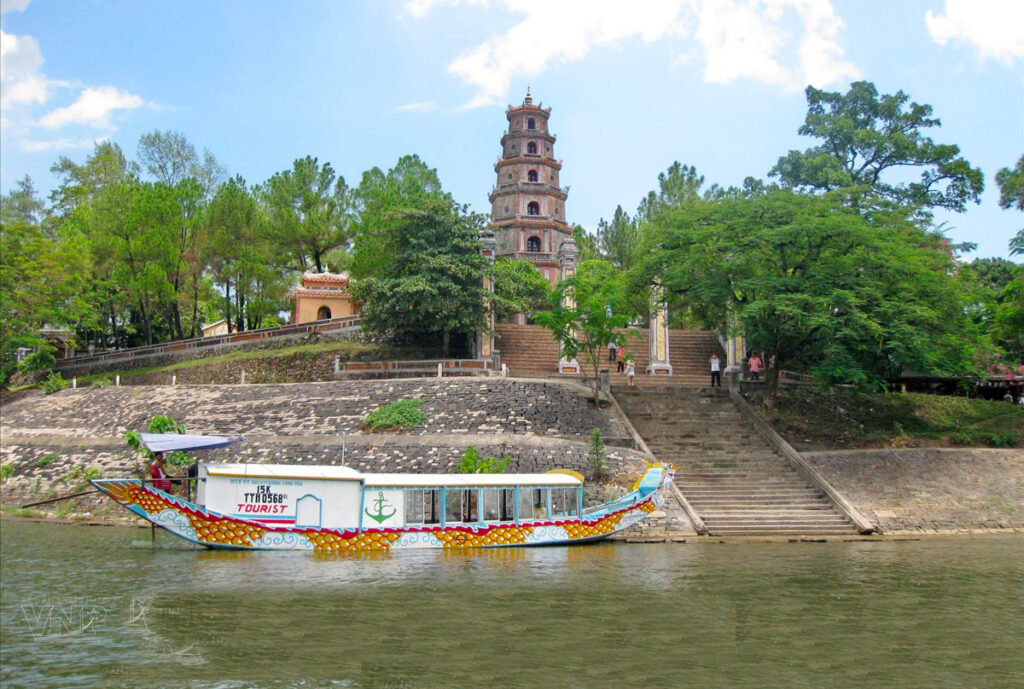
Located right by the Perfume River, just a few minutes from the city center, it offers a peaceful setting with a stunning view over the water and surrounding hills. Yes, it can get a bit crowded, but it’s still manageable if you come early. And honestly, it’s one of the rare tourist spots in Hue that still feels genuinely authentic.
A bit of history without putting you to sleep
Thien Mu Pagoda is the oldest pagoda in Hue. It was built in 1601, during the time of Lord Nguyen Hoang. So yes, it’s been standing by the Perfume River for over 400 years. I’ve added a photo from 1963 further down.
According to historical records, Nguyen Hoang was looking for a good spot to establish his base in the region. While exploring the area, he came across Ha Khe Hill, which, to him, looked like a dragon turning its head. He took it as a good omen and decided to build a pagoda there. He named it Thien Mu, which means “Heavenly Lady.”
Later, in 1862, Emperor Tu Duc changed its name to Linh Mu. He feared that the word “Thien”, meaning “heaven,” might offend the spirits and bring bad luck to his lineage. The original name Thien Mu wasn’t officially restored until 1896.
What to see at Thien Mu Pagoda in Hue?

1. Phuoc Duyen Tower
This is probably the most iconic symbol of Thien Mu Pagoda. You can’t miss it – it stands right behind the entrance gate with its seven octagonal levels, visible from afar. Even though it’s at the front of the site, it’s considered the heart of the pagoda.
It was built in 1844 by King Thieu Tri, and was originally called Tu Nhan Tower. Its current name was given later. At the time, construction wasn’t easy – materials like clay, blue stone, and Bat Trang ceramics had to be brought in from outside Hue, sometimes from far away.
The tower is made of uncoated bricks, with a blue stone facade. Its octagonal shape narrows as it rises, and each floor is about 2 meters high, painted in a light pink color. Over time, the tower has aged, but that only adds to its charm and historical value.
2. The Marble Turtle and the Great Bronze Bell

Right nearby, a large marble turtle catches the eye. In Vietnamese culture, the turtle is a symbol of longevity. This one carries a stele engraved by a Nguyen lord, which describes the renovation of the pagoda. Many students come and touch its head before exams to bring themselves good luck.
You can’t miss the great bronze bell, housed in a small pavilion to the left of the site. It was cast in 1710, under the rule of Lord Nguyen Phuc Chu, and it’s one of the most valuable objects in the pagoda.
It stands 2.5 meters tall and weighs over two tons. Up close, you’ll notice the inscriptions engraved directly into the bronze. These were written by the lord himself, highlighting the importance of the bell at the time. It was used during rituals, but also to broadcast the sacred sound of Buddhism throughout the region. Its echo could be heard all the way to the Perfume River.
3. Tam Quan Gate and Dai Hung Sanctuary

This is the main entrance to the pagoda, located just behind the Phuoc Duyen Tower. You’ll notice three distinct openings, which represent the three realms in Buddhist tradition: the human world, the spiritual world, and the divine world.
The structure is quite impressive, with two levels and eight stacked roofs. On the second floor, right in the center, there’s a statue of Buddha. If you look up, you’ll see the roof peak is finely carved, with some incredibly detailed motifs. And on either side of the entrances, guardian statues are posted, standing watch.


Once you pass through the triple-arched gate, guarded by twelve protective statues, you’ll enter the main sanctuary. Inside, you’ll find three large Buddha statues, each representing the past, present, and future. It’s still an active place of worship, so remember to be respectful and quiet.
4. The Stupa of Thich Don Hau
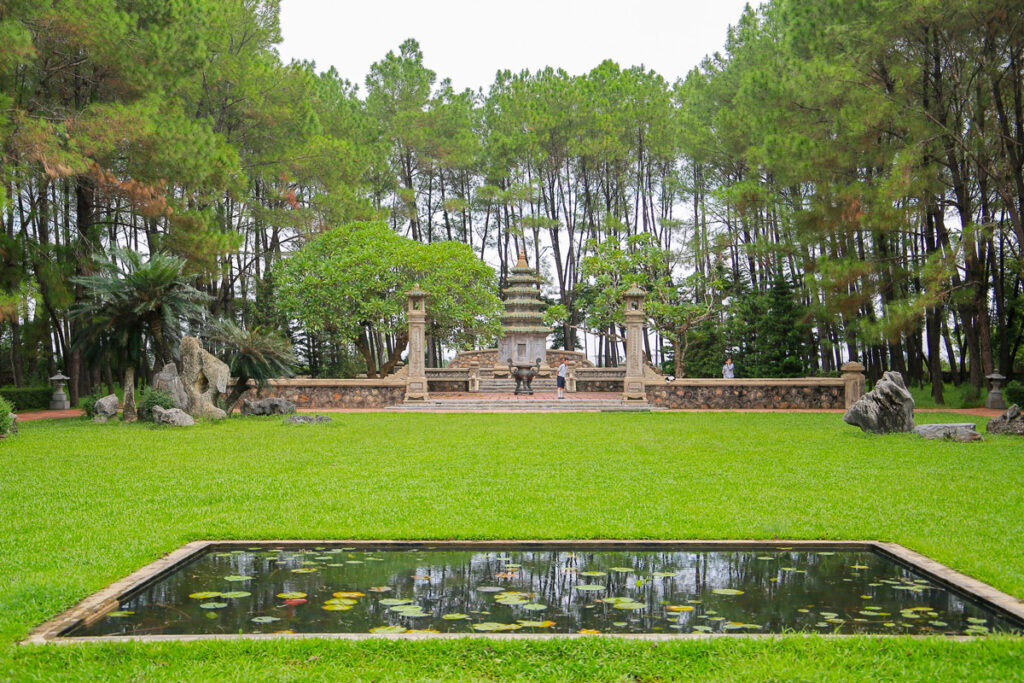
At the far end of the complex, there’s a stupa tucked away a bit from the main path. This is where Venerable Thich Don Hau rests – a former highly respected abbot of the pagoda.
He dedicated his life to promoting Vietnamese Buddhism, but also to charity work and helping the poor through concrete actions. When he passed away, the monks decided to honor him by building this stupa within the temple grounds.
It’s a quiet, discreet spot, but full of meaning, especially if you’re interested in Vietnam’s religious history.
5. Thích Quảng Đức’s Car – A Powerful Symbol

Inside one of the buildings on the site, you’ll come face to face with a light blue vintage car. That’s no coincidence. This is the very car that monk Thích Quảng Đức used to travel to Saigon in 1963, before setting himself on fire in protest against the South Vietnamese regime’s persecution of Buddhists.
Even though the event didn’t happen here, the fact that the car is kept at Thien Mu Pagoda adds another layer to the experience. You don’t expect to come across such a powerful piece of Vietnam’s modern history in such a quiet and peaceful setting. It’s subtle, but it hits hard. No sensationalism, just a silent and direct reminder of a tragic and meaningful moment.
How to Get to Thien Mu Pagoda?

The pagoda is located about 4 km west of Hue’s city center, right along the Perfume River. You can get there by private car, scooter, bike, or even by dragon boat if you want to add a bit of flair to the trip.
Personally, I recommend going by two-wheeler, especially if you’re at least somewhat comfortable on the road. The ride is easy and pleasant, with very little traffic. You’ll follow the river… and in under 15 minutes, you’ll be there. Entrance is free, and there’s a paid parking lot (about 5,000 VND for bicycles, 10,000 VND for scooters) just in front.
If you’re only in Hue for one day, try to include Thien Mu at the start or end of your day, depending on your itinerary. It’s a quick visit and definitely worth it, even if you’re short on time.
In 2019, I visited it with Hoi An Discovery Tours, who offer English and French-speaking guided tours of Hue, including the Imperial City, the royal tombs, and of course Thien Mu Pagoda. Highly recommended.

When Is the Best Time to Visit Thien Mu Pagoda?
Early in the morning (around 7 a.m.) or late afternoon, that’s clearly the best time to go. Not only is it cooler, but there are also far fewer people. You can actually enjoy the peaceful atmosphere, hear the temple bells, and wander around the gardens without being pushed around by tourist groups.
The low-angle sunlight also creates a beautiful light on the river and the octagonal tower. If you’re into photography, that’s when the place is most photogenic. In the middle of the day, between the blistering heat and the tour buses, the mood gets a lot less appealing.
Try to avoid rainy days, the pagoda stays open, but the ground gets slippery, and the view of the river is far less impressive.

Useful Information
- Address: 140–142 Nguyen Phuc Nguyen Street, Huong Long Ward, Hue
- Opening hours: Every day from 7 a.m. to 5.30 p.m.
- Year built: 1601, by order of Lord Nguyen Hoang (founder of the Nguyen dynasty)
- Entrance fee: Free
- Parking: 5,000 VND for a bicycle, 10,000 VND for a scooter
- How to get there: Private car, bus, train, or even by boat along the Perfume River
- Distance from Hue city center: About 5 km
- Recommended visit time: Around 1 hour on site
My Opinion
Thien Mu Pagoda is definitely one of the must-see spots in Hue. It’s not the biggest monument, nor the most spectacular, but it has a genuine and peaceful vibe that really stands out. You don’t feel overwhelmed by tourist crowds, the place is well maintained, and the view over the river brings a sense of real serenity.
It’s a quick visit, but an essential one if you’re in Hue. I really recommend going early in the morning or late afternoon, when the light is softer and the place is quieter. And if you go with a English-speaking guide, you’ll learn quite a bit about the history of Buddhism in Vietnam and the symbols of the site.
In short: easy to reach, free, beautiful, and full of meaning, no reason to skip it.