Hoi An Markets | My Practical Guide

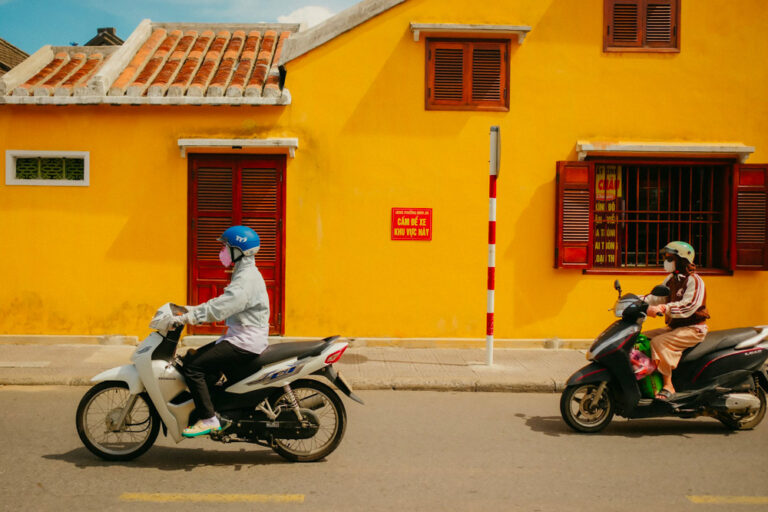
In Hoi An, just one walk through a market is enough to understand how much these places are at the heart of everyday life. Between the smell of fresh fish, the colors of tropical fruits, the shouts of vendors, and the constant noise, you’re immersed in what may seem chaotic but is exactly what makes the charm of Vietnam.
I’ve explored most of the city’s markets: the Central Market, unmissable but touristy; the Night Market, mainly designed for visitors; and the more local Tiger Market. But my favorite is definitely the Ba Le Market, a simpler place, less crowded with tourists, where you can truly enjoy an authentic atmosphere and shop without feeling hassled.
Why visit the markets of Hoi An?

Markets are the best place to feel the heartbeat of a city, and in Hoi An this is true in every alley. You’ll find fresh food, spicy aromas, colorful stalls, vendors constantly calling out, and above all a unique energy you won’t find in any supermarket.
Even though convenience stores and big chains exist, Vietnamese people still prefer their markets for the freshness, the human contact, and… the possibility of shopping directly from their motorbike.
As a traveler, it’s a truly special experience. Whether you want to try a Cao Lau for just a few thousand dong, buy a kilo of mangoes, or simply observe daily life, the markets of Hoi An give you a concentrated taste of local culture.
You’ll find the best and the worst: genuine smiles, sometimes tiring bargaining, memorable dishes, and also a few rip-offs. But it’s exactly this mix that makes the visit unmissable.
Hoi An Market
Hoi An Central Market
You can’t miss the Central Market of Hoi An, located right in the heart of the old town, along the Thu Bon River. It’s the largest and busiest market in Hoi An, a real snapshot of what a Vietnamese market can be: noisy, lively, colorful, and sometimes exhausting.
From as early as 5:00 AM, locals rush in to buy their fresh fish, meat, and vegetables. Later in the day, it’s mostly tourists filling the alleys.
The market is organized into several zones. At the entrance, the food court is the perfect place to taste Hoi An’s iconic dishes without spending much, such as Cao Lau, Bánh Xèo, or the famous White Rose dumplings. Expect to pay between 20,000 and 50,000 VND for a dish and around 20,000–25,000 VND for an iced coffee.
Tip: avoid the central aisle, where the most tourist-oriented stalls are concentrated, and instead head to the alleys on the left and right, which are much quieter and more authentic.


Around the central market, you’ll also find plenty of tropical fruit stalls, as well as vendors selling souvenirs, leather goods, and other everyday items. Finally, towards the river, you’ll come across the wet market with the Vietnamese-style butcher section, where meat is displayed directly on cardboard or even on the ground… an atmosphere that can be overwhelming for sensitive visitors.
It’s a lively and sometimes suffocating place, but still an unmissable stop if you want to experience the full buzz of a Vietnamese market.
Hoi An Fish Market

Right next to the Central Market, along the Thu Bon River, you’ll find the Hoi An Fish Market. There’s nothing extraordinary here – it’s a basic fish market where local fishermen bring their catch early in the morning. You’ll see simple stalls, sometimes directly on the ground, selling shrimp, crabs, squid, and freshly caught fish.
The atmosphere is raw, wet, and noisy, but that’s exactly what makes it an interesting spot if you want to observe everyday local life. It’s not necessarily a place where visitors come to shop, but if you want to understand how Hoi An still relies heavily on fishing, it’s a stop worth making.
The Clothing Market (now also called “Hoi An Market”)

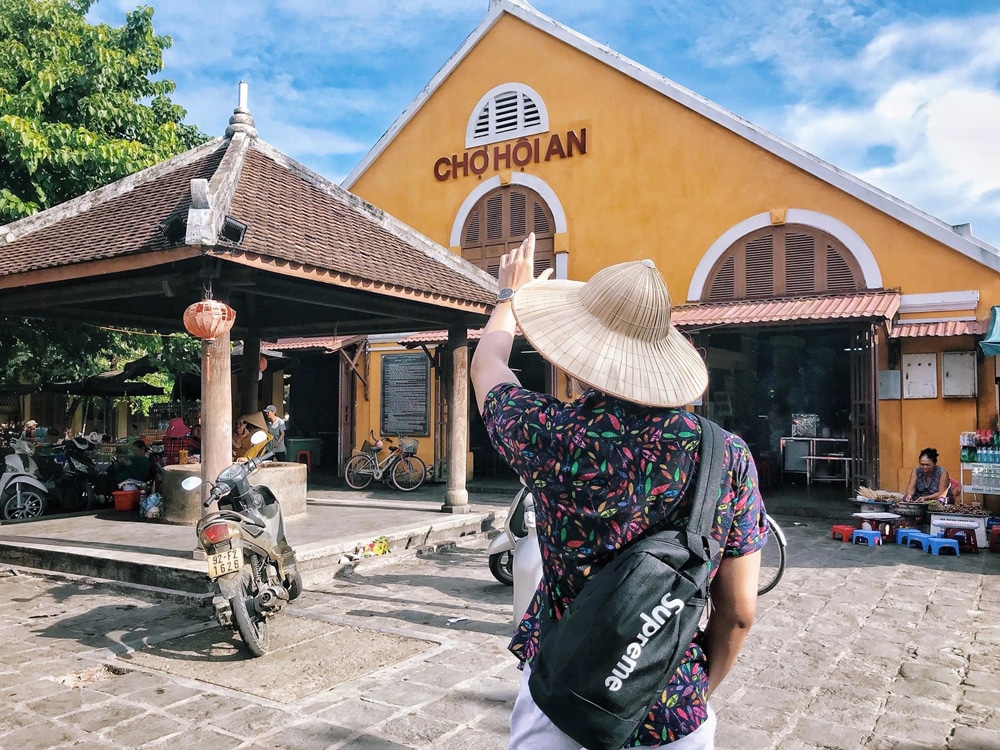
About 100 meters from the Central Market, there’s another building: the Clothing Market, which today is also referred to as “Chợ Hội An” (don’t ask me about the logic). It was rebuilt and expanded in 2015. Before that, it was much smaller because a school occupied the back of the area.
After the school was demolished, a larger building was constructed, which explains why there are now two separate markets divided by a few alleys, both called “Hoi An Market.”

The former Clothing Market
This market is mainly dedicated to textiles: you’ll find many tailors who are trending on TikTok thanks to their low prices, as well as stalls selling silk, souvenirs, and ready-to-wear clothes. This is where many visitors come to order a custom-made suit or dress, and also to buy Hoi An’s famous lanterns.
The atmosphere here is different from the Central Market: no food stalls, less noise, but still the need to negotiate. For me, it’s a complementary market, worth visiting if you’re looking to leave with a unique piece of clothing or an artisan souvenir.
In my recommendations, I’d suggest stopping at the Market Bar – Market Terrace if you’re in the mood for a drink with a view over the river. As for tailors, my favorite is Sewing Bee, although I’ll be honest: living here, I usually just go to Mr Xe Tailor Hoi An.
Tip: if you go to the left side of the fabric market, you’ll find many gold vendors. This is where you can get one of the best euro–dong exchange rates.
Ba Le Market – Chợ Cẩm Châu
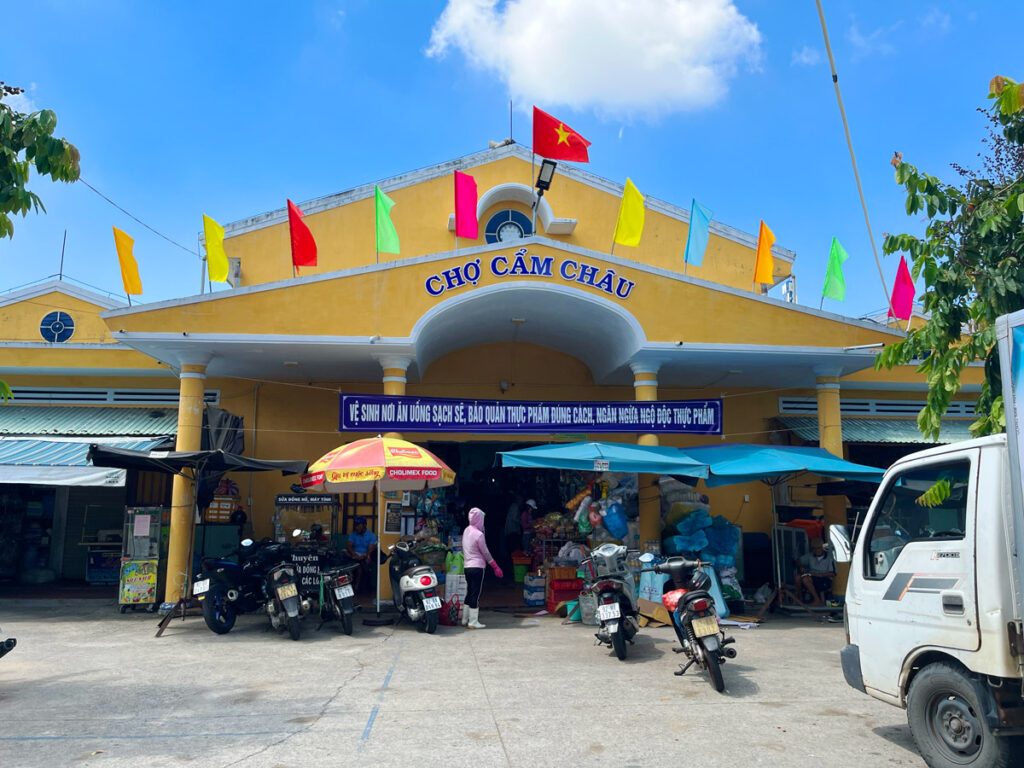
Officially called Chợ Cẩm Châu, this market is nicknamed Ba Le Market in reference to Madame Lê’s house, which once stood nearby. Located halfway between the Old Town and the beach, it’s a place I particularly enjoy. For a long time, it was mainly frequented by local residents, with a simple and quiet atmosphere.
You could say this market is still local and authentic, yet it’s actually the second largest market in Hoi An after the Central Market. It is divided into several distinct sections, separated by streets, giving it the feel of a small labyrinth.
The main building is dedicated to clothing: you’ll find everyday garments, fabrics, and even a few stalls offering alterations. If you keep going straight, you’ll reach the wet section, with meat stalls (sometimes placed directly on the ground) and fresh seafood.


Other parts are dedicated to fruits. Finally, to the left, there’s a food court where you can try local specialties like Cao Lau or Mi Quang, freshly cooked on the spot for unbeatable prices.
Nowadays, you’ll see a few more tourists than before, mainly because some cooking classes bring their participants here to buy vegetables and fresh herbs. Despite that, the market has kept its charm and authenticity, far from the bustle of the Central Market.


You’ll find fruits, vegetables, meat, poultry, and fresh seafood (especially early in the morning and late in the afternoon), but also plenty of cheap food options. A bowl of rice with toppings costs under 30,000 VND, and you can enjoy an iced coffee among the best in Hoi An for just 15,000–25,000 VND. Fresh smoothies (Sinh Tố) are also a real treat.
Unlike the Central Market, you won’t find souvenirs or tourist trinkets here, and that’s exactly why I consider it a truly local and authentic market.
Of course, few vendors speak English, but that’s part of its authenticity. For me, it’s the most pleasant market in Hoi An, and the one I recommend if you want to discover local life without stress.
Tiger Market – Chợ Tân An

Next to the Ông Cọp Temple stands Chợ Tân An, better known as Tiger Market. It’s probably the smallest of the three main markets in Hoi An (along with the Central Market and Ba Le Market), but it has its charm. The atmosphere here feels more local than in the Old Town, with fairer prices and vendors who are far less pushy.
You can find everything here: fruits, vegetables, meat, and fresh fish. Just across the street, there’s also a small grocery called Hanh Nga, which used to be a go-to spot for expats. Back then, it was one of the few places where you could find Western products otherwise unavailable in Hoi An (cheese, olive oil, chickpeas, etc.). Nowadays, these items are available in several minimarts across town, but Hanh Nga is still a well-known reference.

The downside is that Tiger Market feels more suffocating than the others: the alleys are narrower, air circulation is poor, and the atmosphere can quickly become oppressive during peak hours. Still, if you’re looking for a less touristy market, this one is an interesting alternative.
Why the name “Tiger Market”?

The Tiger Market is located just a few meters away from the Ông Cọp Temple (which literally means “Mister Tiger”). The name often intrigues visitors, but it comes from a local legend: long ago, a wounded tiger came to the hamlet of Xuân Mỹ seeking refuge. The villagers tried to heal it, but the animal eventually died of its injuries. To honor it, they built a temple.
Others explain the name by the sculpted screen of the temple, where a tiger is shown baring its fangs, a symbol of strength and respect. In any case, as is often the case in Vietnam, the place inherited the name of the story or the image tied to it.
Thanh Ha Fish Market

If you want to see a raw, no-frills market, the Thanh Ha Fish Market is a unique experience. You’ll need to get up very early: by 5:00 AM, fishermen unload their night catch and women organize the wholesale sales for Hoi An’s restaurants. The atmosphere is loud, intense, sometimes even aggressive, but that’s exactly what makes it so fascinating.
You’ll see fish of all sizes, clams, shrimp, and squid, all sold quickly, often by auction. Some scenes can be surprising: shouting, jostling, bags of shellfish pushed into customers’ hands, and a constantly wet floor. In other words, bring the right shoes.
This market loses its interest after 7:00 AM, when most of the trading is already finished. It’s not really a place where I go to shop, unless you have a kitchen and want to prepare your own seafood feast. But if you want to observe local life in its rawest form, it’s a stop I highly recommend, provided you’re not afraid of the chaos.
Hoi An Night Market
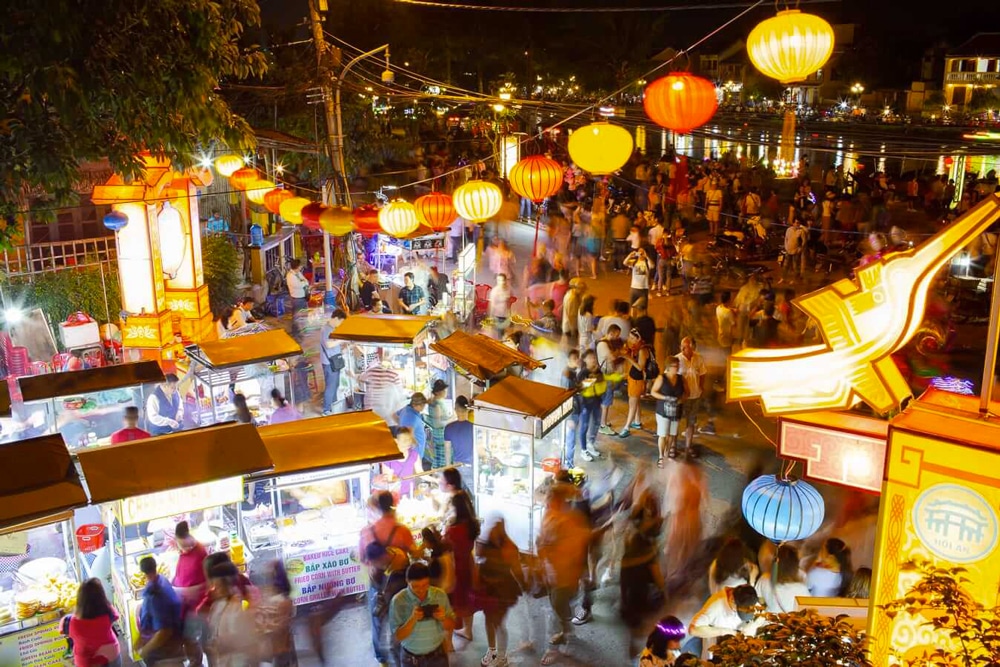
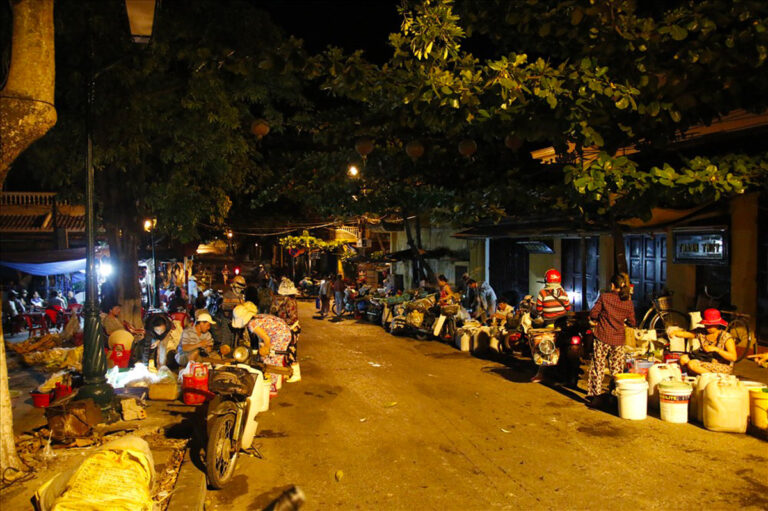
Located on An Hội Island, just across from the Old Town, the Hoi An Night Market is without a doubt the most tourist-oriented. Every evening from 5:00 PM to 11:00 PM, Nguyen Hoang and Nguyen Phuc Chu streets fill up with souvenir and snack stalls. Motorbikes are banned here, so you can stroll around freely but you need to enjoy crowds: after dark, it’s absolutely packed with people.
You’ll mostly find mass-produced souvenirs: lanterns, fans, dreamcatchers, magnets… Honestly, the items repeat from stall to stall, and prices are inflated. If you want to buy something, you’ll need to bargain right from the start. Personally, I don’t think it’s the best place for real deals.
On the other hand, it’s a fun spot for snacking. Food stalls serve Bánh Mì, Bánh Xèo, smoothies, banana pancakes, rolled ice cream, and plenty of other treats. It’s also a great place to enjoy the lanterns lit up at night and soak in the lively atmosphere, even if it’s clearly designed for visitors.
In short: if you’re looking for a local culinary experience or immersion in Vietnamese daily life, you won’t find it here. But for an evening walk after dinner, surrounded by lanterns and energy, it remains a Hoi An classic.
My Opinion
I’ve explored all the markets of Hoi An several times, and each one really has its own personality. The Central Market is a must if you want to feel the raw energy of the Old Town, but it’s also the place where you’ll be hassled every two minutes and where prices are inflated. The Tiger Market, smaller and more suffocating, is still worth it if you’re after a more local and less touristy atmosphere. But my favorite, without a doubt, is the Ba Le Market, quieter, more authentic, and perfect for observing everyday local life without stress.
In the end, it all depends on what you’re looking for: buzz, authenticity, or practicality. Personally, I go to the Central Market when I have friends visiting, to the Tiger Market if I need a specific ingredient, and to the Ba Le Market when I just want to shop calmly and enjoy a good cà phê sữa đá among locals.