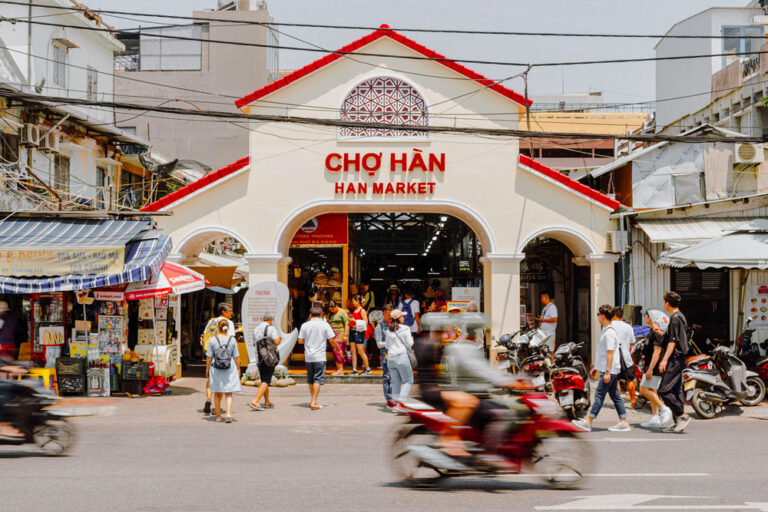
Dong Ba Market in Hue | Is It Really Worth a Visit?

When visiting Hue, you will almost always hear about Dong Ba Market. It is the largest market in the city and also one of the oldest. Many travelers come here to experience the local atmosphere, taste some Hue specialties, or buy souvenirs.
The question many visitors ask is simple. Is Dong Ba Market really worth visiting during a trip to Hue? Is it an interesting place to discover the city, or just another market like many others in Vietnam?
Let’s take a look at what you can actually do there, what you will find inside, and whether the visit deserves a place in your itinerary.
Where is Dong Ba Market located?
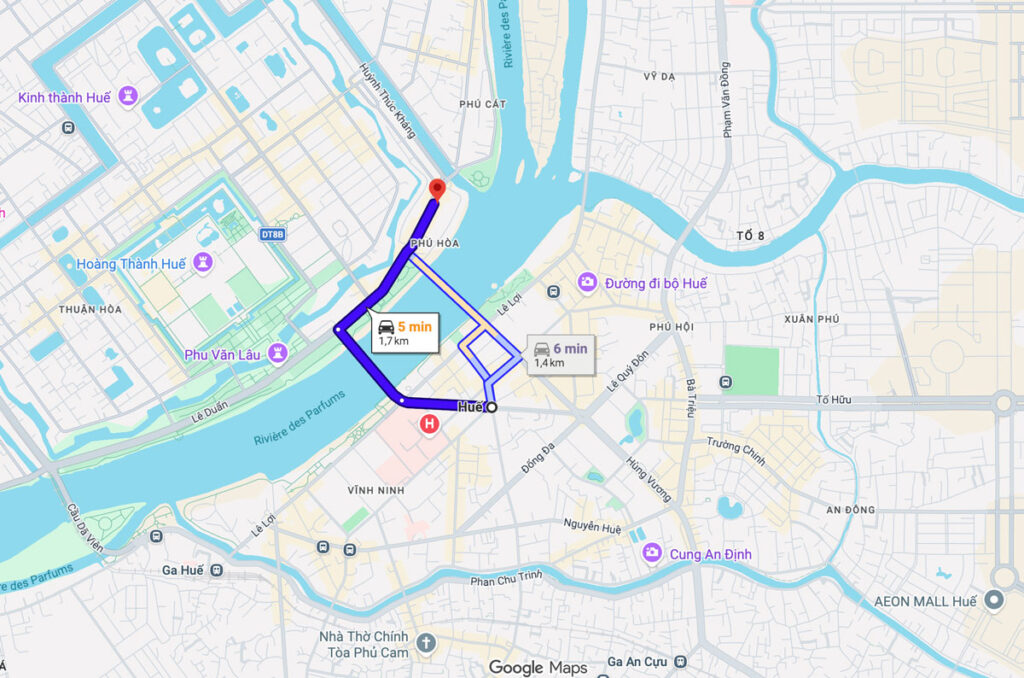
Dong Ba Market is located right in the center of Hue, on the north bank of the Perfume River. The exact address is 2 Tran Hung Dao Street, Phu Hoa Ward, Hue City. It sits between Truong Tien Bridge and Gia Hoi Bridge, two of the most well-known bridges in the city.
If you are staying in central Hue, you can easily reach it on foot, by taxi, or by scooter. Many visitors actually pass in front of the market while walking along the Perfume River. In that case, you just need to cross the street to enter.
From the outside, the building does not look particularly impressive. At first glance, it might even appear to be just a regular neighborhood market. However, once inside, you quickly discover a much larger space than expected, filled with stalls and narrow aisles where activity almost never stops.
A brief history of Dong Ba Market

Dong Ba Market dates back to the late 19th century. It was established in 1887 during the reign of Emperor Dong Khanh. At the time, it did not yet carry its current name. It was originally called Quy Gia Thi, before being renamed Dong Ba a few years later.
In its early days, it was not the large market we see today. It started as a temporary market where vendors, often women, sold their goods from baskets and trays placed on the ground. Over time, commercial activity grew and the market gradually became a central place for the people of Hue.
Over the decades, Dong Ba evolved alongside the city itself. It went through periods of transformation, reconstruction, and modernization. Even today, it remains an important part of the local economy and a place where you can observe everyday life in Hue.
My experience at Dong Ba Market in Hue
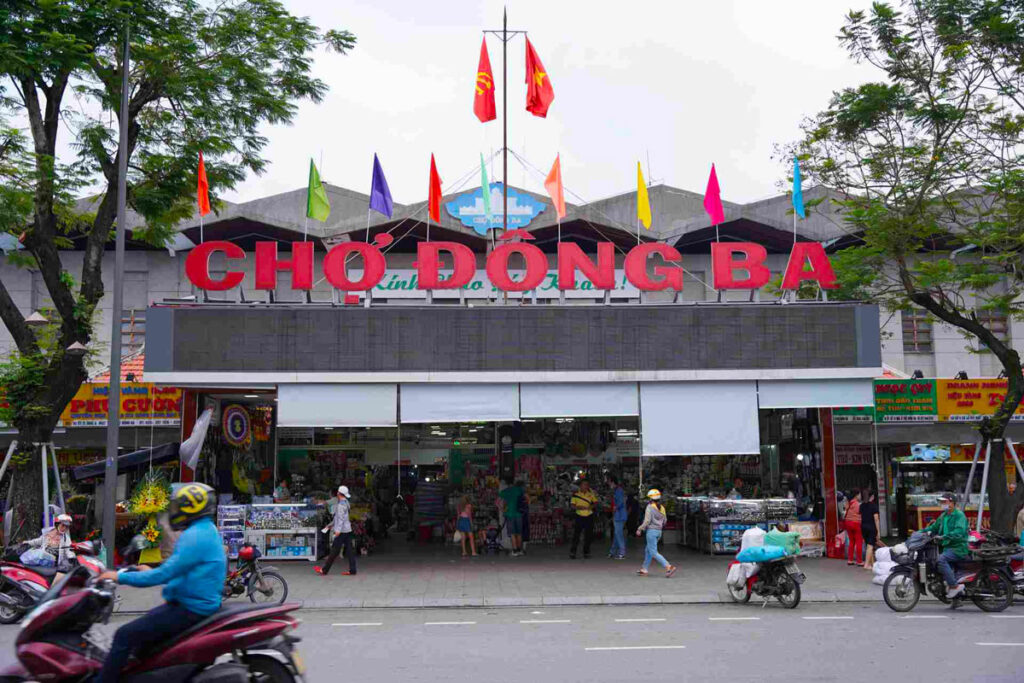
When I visit a market in Vietnam, it is usually not to buy souvenirs. I mainly go to eat and see what locals are actually eating. Dong Ba Market is no exception. As soon as you step inside, you quickly realize that the place is much bigger than it appears from the outside.
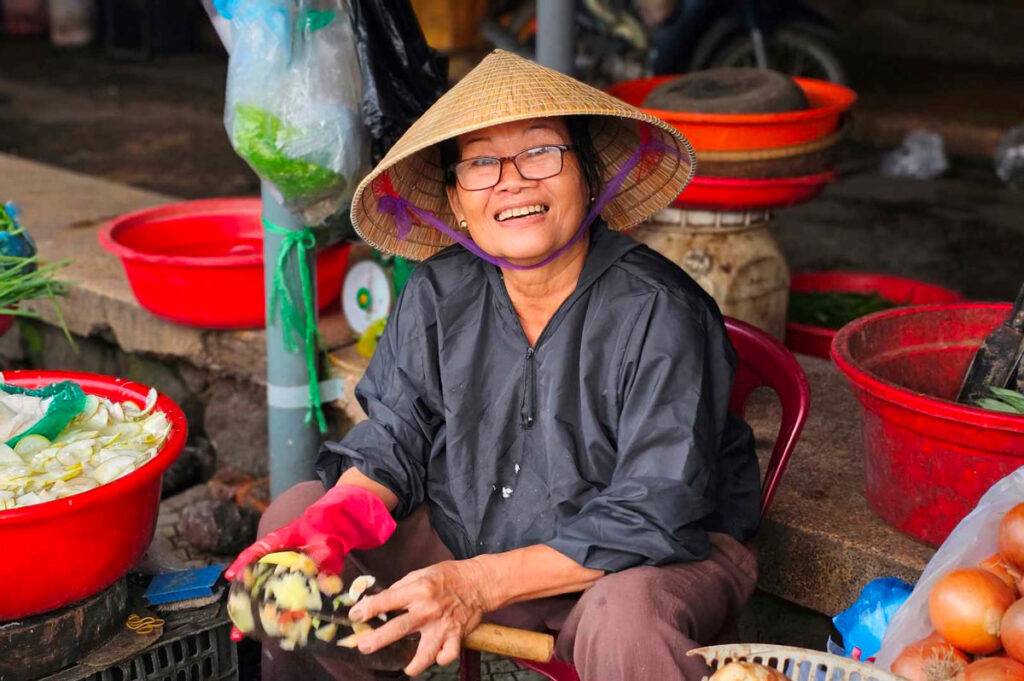
The main building covers about 15,000 m² and is organized across three floors filled with stalls. The structure is built around a large central block surrounded by aisles and small shops. Like many Vietnamese markets, the atmosphere is lively. The aisles can be narrow, stalls are packed with goods, and vendors regularly call out to passersby. You will see a mix of locals doing their daily shopping and curious travelers exploring the market.
Once inside, the market is actually quite easy to understand. It is divided into different sections, which helps you navigate through it. Some areas focus on clothing, others on souvenirs, and others on food products. It can feel a bit chaotic at times, but that is also part of the charm of Vietnamese markets. You simply walk through the aisles, look at the stalls, and gradually discover what is sold here.
First floor: food and local products


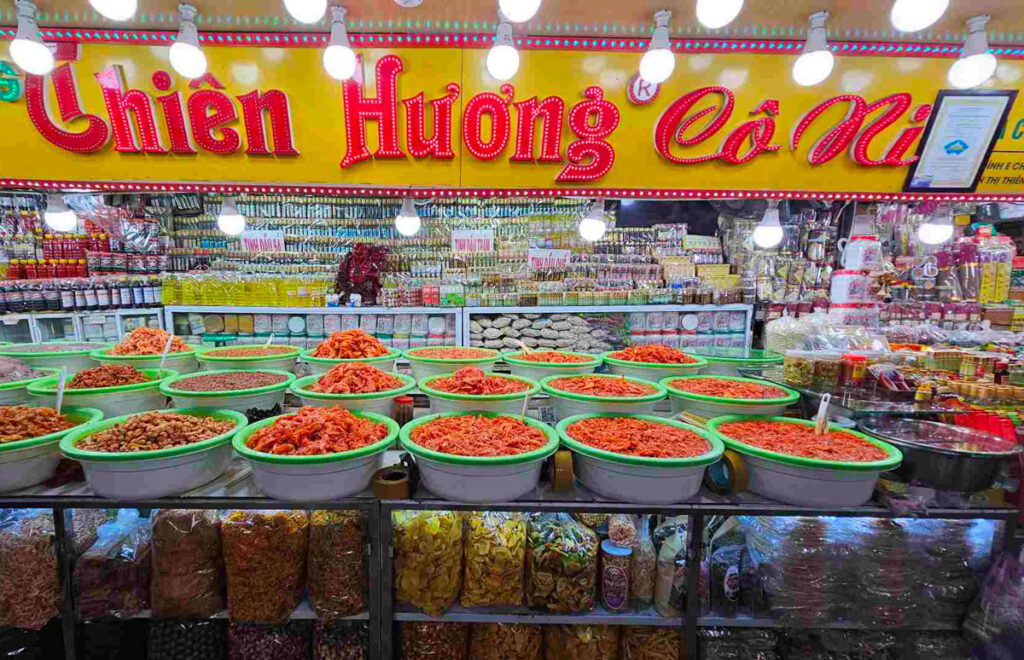
To be honest, the area that interests me the most is the first floor, which focuses on food and local ingredients. Here you will find different types of fish sauce, fermented shrimp paste, dried seafood, and spices typical of central Vietnam. Even if you do not plan to buy anything, it is a great place to see the ingredients used in local cooking and better understand the flavors of the region.
Second floor: souvenirs and handicrafts
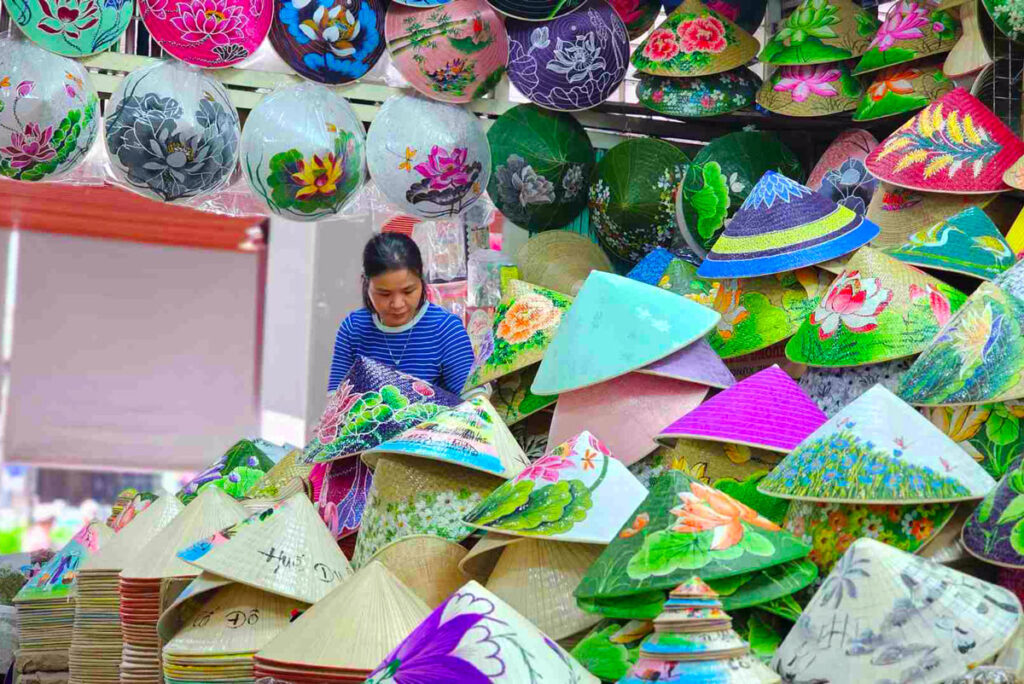
The second floor is more focused on souvenirs and handicrafts. You will find many typical Hue items such as conical hats, bamboo and rattan products, ceramics, and small souvenirs that are easy to pack in a suitcase. This is usually where most visitors spend their time.
To be honest, I rarely go to markets to buy souvenirs. Like in many markets across Vietnam, prices are often much higher for tourists. I mainly come here for the atmosphere and especially to try the food.

Third floor: fabrics
The third floor is mainly dedicated to fabrics and clothing. It is a colorful space where you can find different types of textiles, including those used to make ao dai, the traditional Vietnamese dress. If you are interested in fabrics or tailoring, this is probably the most interesting level.
What to eat at Dong Ba Market?
If you enjoy Vietnamese food, Dong Ba Market is also a good place to discover several specialties from Hue. Around the market and in some of the aisles, you will find small food stalls where locals come to eat quickly. The atmosphere is simple. A few low tables, plastic chairs, and dishes prepared right in front of you.
Nem lụi Huế
One of the most well-known dishes here is nem lụi Huế, grilled pork skewers typical of central Vietnam. They are served with fresh herbs, rice paper, and a thick sauce made with fish sauce. You wrap everything together in the rice paper before dipping it into the sauce. It is simple but very flavorful.
A portion for two people costs around 50,000 VND, which is extremely affordable.
Bún bò Huế
Another must-try dish is bún bò Huế, the famous beef noodle soup from the city. You can find it in many restaurants around Hue, but some stalls inside the market also serve it. The broth is rich, slightly spicy, and quite different from other Vietnamese soups.
You can expect to pay around 15,000 to 20,000 VND for a bowl of this noodle soup.
Bánh bèo
You will also see stalls serving bánh bèo, small steamed rice cakes topped with dried shrimp. They are usually served with a slightly sweet and salty dipping sauce. It is a very local specialty that you will often find in markets or small eateries in Hue.
Chè Huế
If you want to finish with something sweet, try chè Huế. These are traditional Vietnamese desserts often served in bowls or glasses. They can include beans, fruits, jelly, or coconut milk. The taste is mild and refreshing, which makes it a nice break after trying several savory dishes.
Tips for visiting Dong Ba Market
If you plan to visit Dong Ba Market, a few tips can help you enjoy the experience a bit more. Like in many markets in Vietnam, the time you visit completely changes the atmosphere.
The market opens very early, around 3 AM, because this is when vendors and local traders come to restock their goods. At that time, the place is mainly busy with locals. For visitors, it is not necessarily the most enjoyable moment to walk around. Vendors are focused on business and the atmosphere is more about trading than exploring.
If you want to explore the market more comfortably, late morning or the afternoon is usually a better time. The market is still lively, but you will have more time to walk through the aisles, look at the stalls, chat with vendors, and try a few local specialties.
For reference, Dong Ba Market is generally open from 5 AM to 7 PM.
My opinion
To be honest, Dong Ba Market is not necessarily a must-see in Hue. If you have already visited several markets in Vietnam, you will probably find a similar atmosphere here to what you see in many other cities across the country.
Personally, I do not go to markets to buy souvenirs. Like in many Vietnamese markets, prices are often higher for visitors, and you can usually find the same products cheaper in some shops around the city. If your goal is shopping, this might not be the most interesting place.
However, the market can still be worth a visit if you want to experience the local atmosphere and especially try a few Hue specialties. That is usually why I stop by when I am in the city. You walk through the aisles, observe daily life, and stop at a small stall to eat something.
If you have some time, it can be a nice stop to combine with a walk along the Perfume River, since the market is located just nearby. But if your schedule in Hue is tight, it is not an essential visit.