Kien Trung Palace in Hue: Is It Really Worth Visiting?

The Kien Trung Palace is one of the latest buildings to reopen inside the Hue Imperial City. Closed for decades, it was fully restored and reopened to visitors in January 2024 after several years of work.
This palace stands out within the citadel. Unlike other imperial buildings, it combines traditional Vietnamese architecture with Western influences, especially French and Italian. You notice the difference immediately when you arrive.
During my visit to the citadel with Lam from Hue French-speaking guide, I took the time to stop by this palace, mainly out of curiosity after its recent reopening. You’ll see that the visit is interesting, but it may not match what you expect when visiting Hue.
Where is Kien Trung Palace located?

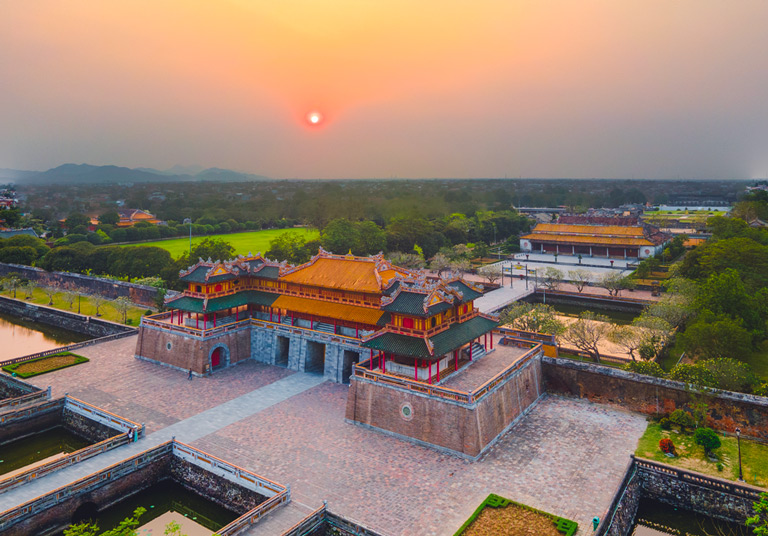
The Kien Trung Palace is located inside the Hue Imperial City, in the most restricted area known as the Purple Forbidden City.
Its official address is 32 Dang Thai Than, in the Phu Hau area, but in reality, you can only access it by entering the citadel.
The palace sits at the end of the central axis of the Imperial City. This axis includes several important buildings such as:
- the Thai Hoa Palace
- the Can Chanh Palace
- the Can Thanh Palace
- the Khon Thai Palace
Kien Trung Palace is therefore one of the last buildings you’ll see when following this route.
What to know before visiting
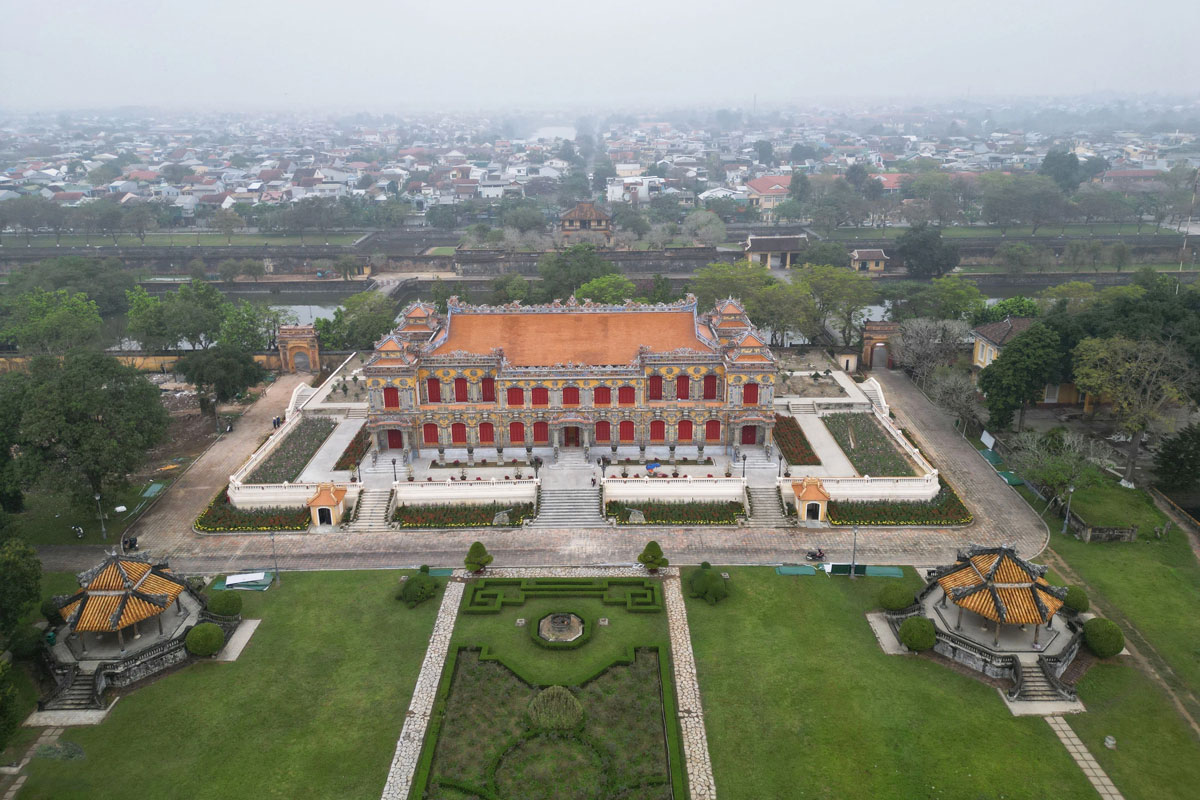
The Kien Trung Palace is easy to visit as part of your exploration of the Hue Imperial City.
- Opening hours: summer: 6:30 AM – 5:30 PM, winter: 7:00 AM – 5:00 PM
- Price: included in the Imperial City ticket, around 200,000 VND per person
- Visit duration: around 15 to 30 minutes
- Access: located inside the Imperial City, on the central axis
A brief history of Kien Trung Palace

The history of the Kien Trung Palace is more complex than it seems, as several buildings stood on this site before the current palace.
Before Kien Trung Palace
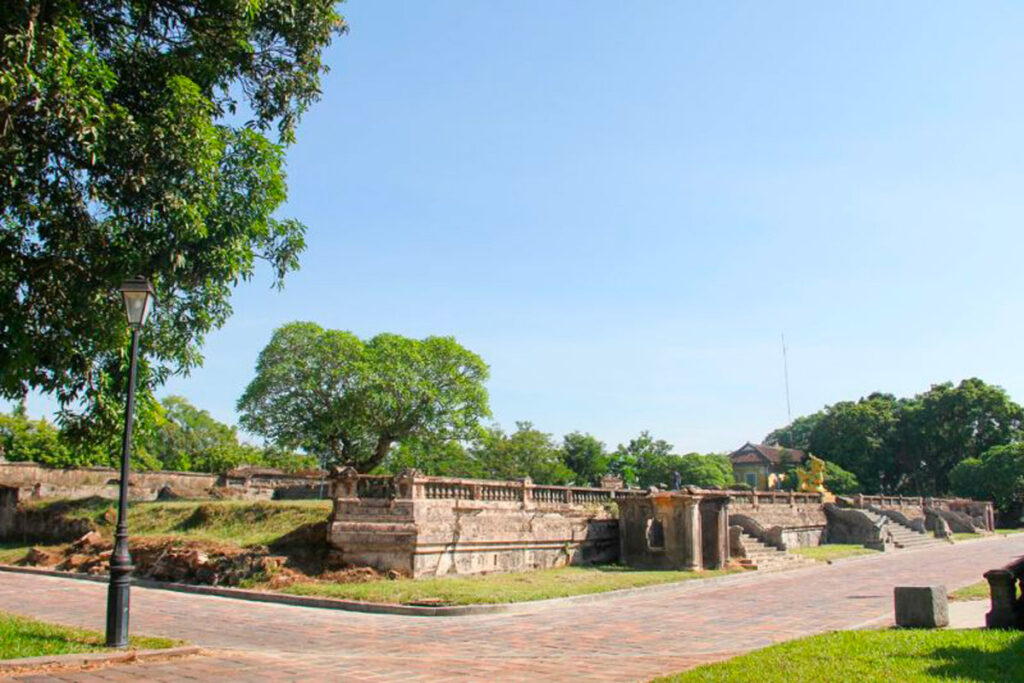
In 1827, Emperor Minh Mang ordered the construction of the Minh Vien Pavilion on this site. It stood about 10.8 meters high and was used as a place to relax and enjoy the view within the imperial enclosure.
Under Emperor Tu Duc, the pavilion was eventually completely destroyed.
From Du Cuu Pavilion to Kien Trung Palace
In 1919, Emperor Duy Tan had a new structure built on the site: the Du Cuu Pavilion.
Later, under Emperor Khai Dinh, the structure was expanded and transformed into a palace, renamed Kien Trung. It became the emperor’s main residence within the Imperial City.
Under Bao Dai

In 1932, Emperor Bao Dai renovated the interior and added several modern Western features, including a bathtub. This reflects how the palace evolved into both a Vietnamese imperial residence and a place influenced by the West.
After the August Revolution, Kien Trung Palace also became an important historical site. It was here that Bao Dai met the provisional government delegation to discuss his abdication.
Destruction during the war
The palace was heavily damaged during the conflicts of the 20th century. In 1947, it was completely destroyed, leaving only the foundations.
A recent restoration

The restoration project started in 2019, with the goal of rebuilding the palace while respecting its original structure as closely as possible.
The work was completed in early 2024, after several years of construction. The palace was then reopened to the public, becoming one of the few buildings in the citadel to have been fully reconstructed in recent years.
What to see at Kien Trung Palace
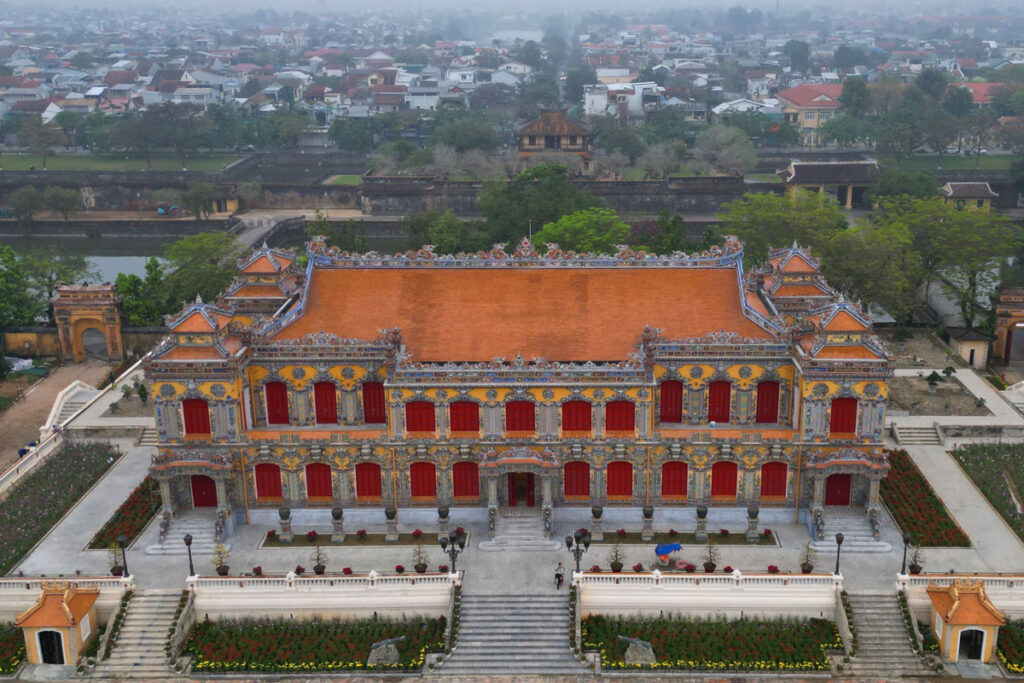
The visit to Kien Trung Palace is fairly short, but the main interest is not only inside. In reality, what stands out the most is the exterior decoration of the palace, which looks very different from the rest of the Imperial City.
Unlike other buildings in Hue, the facade here is richly decorated with many porcelain and glass motifs. These details are highly elaborate and give the palace a more ornate and more Western feel than the other buildings in the citadel.

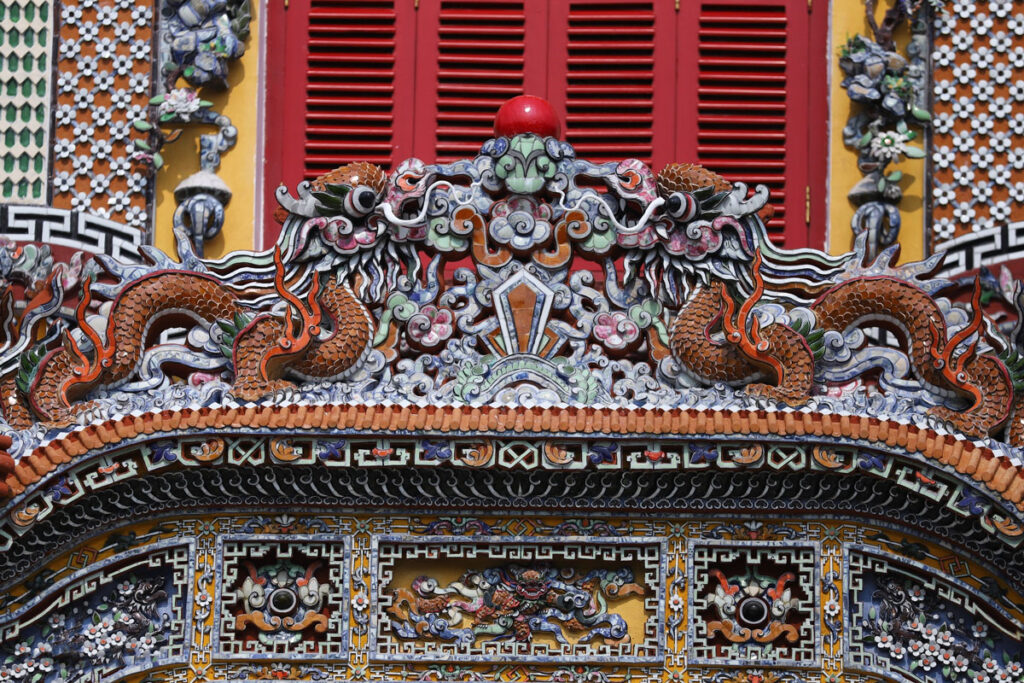
This is clearly one of the few places in Hue where I recommend stepping back and looking at the building as a whole.
Inside, the visit is quicker. You can see a few objects linked to Emperor Khai Dinh, such as:
- clothing
- porcelain and bronze objects
- a palanquin used by the emperor
Some of these objects are displayed on the ground floor.
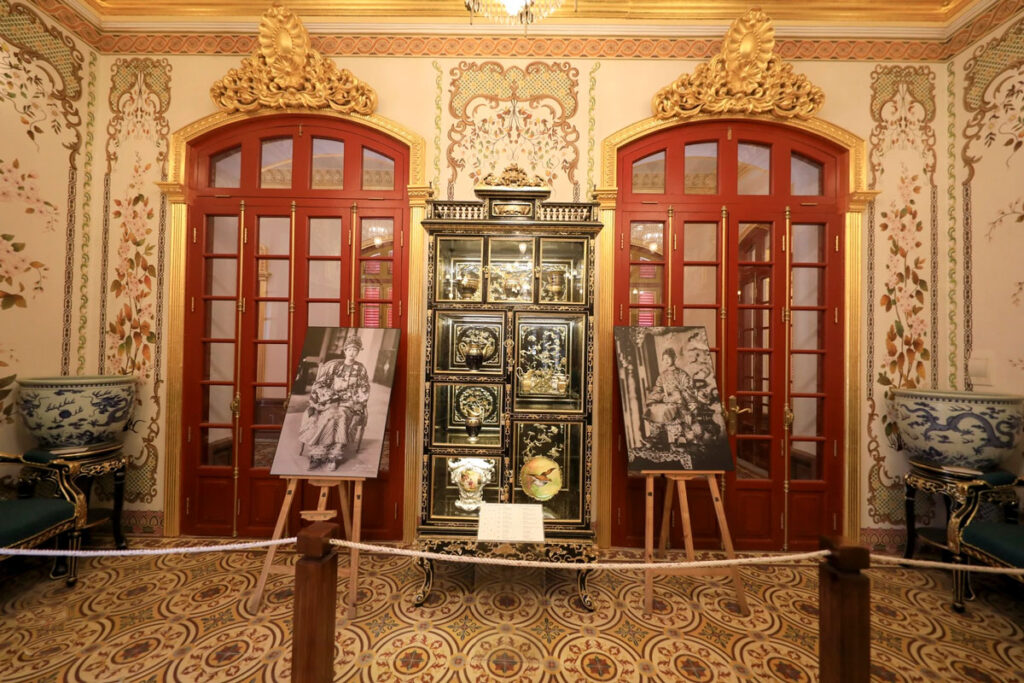

But in practice, that is not what leaves the strongest impression.
I mainly recommend taking the time to look at:
- the exterior decorations, which are very elaborate
- the porcelain inlays
- the dragon-decorated staircases
- the details of the facade
The visit is short, but if you simply walk quickly through the interior, you may miss the palace’s main appeal.
Is Kien Trung Palace worth visiting?

If you are wondering whether Kien Trung Palace is worth visiting, here is my opinion after walking through it inside the Imperial City.
What I liked
- A recently restored palace, which allows you to see an imperial building in a condition close to its original state
- An architecture different from the rest of the citadel, with a mix of Vietnamese, French, and Italian influences
- The exterior porcelain decorations, which are truly unique within the citadel
- Located on the central axis of the Imperial City, making it easy to include in your visit
- The possibility of seeing objects linked to the last emperors of the Nguyen dynasty
What I liked less
- A result that sometimes feels too “new”, which takes away some of the historical atmosphere you find elsewhere in Hue
- A fairly short visit
- Less impressive than some other sites in the citadel, such as Thai Hoa Palace
- A concentration of visitors in this area since its reopening
My opinion
Honestly, Kien Trung Palace is worth a stop, but it is not the most striking site inside the Hue Imperial City either.
What I found most interesting is its unusual architecture. It clearly moves away from the classic Hue style, with a visible mix of Vietnamese and Western influences, especially on the facade and in the porcelain decorations. In my opinion, that is the palace’s main appeal.
On the other hand, the fact that the palace is entirely reconstructed is noticeable. The result sometimes feels a bit too clean, almost brand new, and you lose some of the authenticity you still find in other parts of the citadel.
The visit is also quite short. You can easily spend 15 to 20 minutes here, especially if you continue on to the other nearby palaces.
If you are visiting the Imperial City, I recommend stopping by without hesitation, because it fits naturally into the route. But I would not make a special detour just for it.